Amicus Curiae
I don't know. I have been forced to use the "Fishbone" root cause method for my many failures. In theory, it forces a reluctant design team to examine their work and admit the baby is ugly by submitting to a team of experts with no axe to grind. In reality, it always becomes a way for the ambitious to be noticed, and they flock to it. It is imperative for such a person to get a "bone" on the chart, no matter how bone-headed it is. Then it has the same status of all legitimate possibilities until removed by reasonable analysis/test. Analysis and test cost time and money. In my experience, the most unlikely cause always takes the most time and money to debunk. The task often degenerates into personal struggles for dominance. I have even had people on fishbone review teams whose sole purpose was to extract revenge for a prior personal conflict. Selection of a knowledgeable chairman who not only can understand the technical presentations, but also knows the personalities involved is a big help. Then, the Mickey Mouse is cut to a minimum.
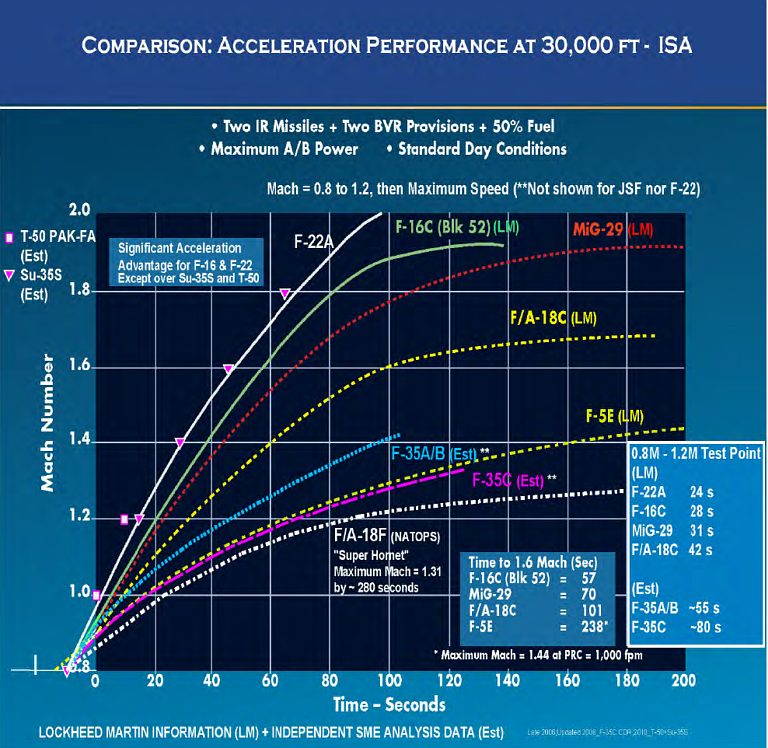
Here are some interesting words from him from a previous post on the F-35C topic. I have created a simple chart to go with it and then added my comments at the end.

Amicus Curiae
Well, no, I confess to a little hyperbole there. I failed to emphasize the jet needs to throw away commonality and get an engine upgrade. Possibly I was deliberately inviting a challenge?
My own calculations show the current status of the F-35C at 48,000 lb gross weight, 50% fuel and 4 internal missiles, to have a 50,600 ft/min initial climb rate. Time to climb to 40k ft from brake release is 2.3 min.
Old, less reliable, calculations of mine for the F-4 at 39000 lbs, which is roughly 50% fuel and 4 external missiles, show about the same climb rate of 51500 ft/min. Both the F-16 and F-18 climb at 65k ft/min with the same load. The Mirage 2000 and Gripen are in the 50k ft/min zone, again with the same missile load. The Rafale is in the >65k ft/min zone.
The F -15 at 35.5k lbs gross weight with the 4 missile external load manages an initial climb rate of 74k ft/min. For some comparison, the same methods used above give an F-22 at 55,500 lbs weight (which is equivalent to a full load of 8 missiles, 50% fuel) is capable of 78,000 ft/min initial climb. I guess that should be the "rocket" to compare them all to, but everyone knows the F-35 is better, right? After all, 35 > 22 so the F-35 is 35/22= 1.59 times better than the F-22. It is a bargain if it costs the same. That's as good a story as the official one.
Also on the topic of all F-35s: acceleration shown on this prediction chart. Is this the bigger F-35C wing? It being overweight to its 2002 design config by 15 percent? Limits of the engine capability? All? Some? Something else?

No comments:
Post a Comment